What is an AI sports camera?
Automated cameras have become a familiar sight on sidelines across nearly every team sport. This article explains what an AI sports camera is, the three things they all do, and how the main types differ — then points you to our buying guide for a closer look at the trade-offs.
What an AI sports camera does
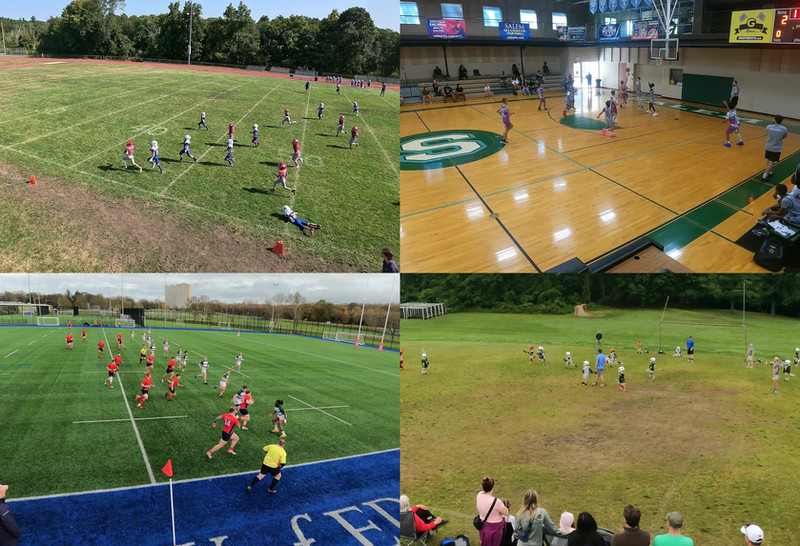
An AI sports camera automates the recording, creation, and sharing of full-game and highlight videos. A few years ago these devices were known mostly as "soccer cameras," but the same technology now covers American football, basketball, volleyball, rugby, lacrosse, field hockey, and ice hockey. Whatever the sport, almost every AI sports camera shares the same three basic features:
- Hands-free recording. The camera sees the entire field or court, so nobody has to aim or operate it during the game.
- Automatic video creation. AI processes the raw footage into videos that follow and zoom in on the action, with manual editing optional rather than required.
- Upload and sharing. The finished game and highlight videos are uploaded to the cloud, where the whole team can watch, download, and share them.
The appeal is straightforward. Because no one has to stand behind the lens, parents, coaches, and officials can focus on the game itself, and the camera can sit on a much lighter tripod than a manual camcorder setup would need. The footage then does real work afterward: highlight reels to share with family, game film for review, and recruiting clips for players hoping to move up to higher-level teams.
The main types of AI sports camera
Although they look broadly similar sitting on a tripod, AI sports cameras take a few different technical approaches under the hood. There is no single best one — only the best one for a given team and budget. The three you are most likely to encounter are robot cameras, full-field systems, and cloud-AI cameras.
Robot cameras
A robot camera uses a mechanical gimbal that physically pans to follow the game. It usually carries two lenses: a wide fisheye lens that lets the on-board AI see where the action is, and a second lens that records the footage itself. Because the AI runs on a small chip inside the camera, robot cameras tend to be the lowest-cost option up front, and many work without a subscription. The trade-off is that the camera only films where it happens to be pointed, so a fast break can slip out of frame, and windy conditions can unsettle the tracking.
Full-field camera systems
A full-field system uses a fixed, non-moving dual-lens setup that captures the entire field at once, with the AI running on the device, in the cloud, or some combination of the two. Because nothing has to physically turn, the whole field is always in view, which supports accurate tracking and per-player analytics. These systems are generally aimed at elite and top travel teams that want deep analysis, and they tend to be the most expensive option.
Cloud-AI cameras
A cloud-AI camera keeps the full-field idea but moves the heavy AI work off the camera and into the cloud, where far more processing power can analyze the raw footage at its native resolution. This is the approach SeeUsPlay takes, using standard GoPro action cameras as the hardware. Recording in resolutions up to 8K and processing in the cloud — roughly a hundred times the power of a small on-camera chip — produces sharp, well-tracked video, and because the cameras are ordinary GoPros, they stay useful the rest of the week.
| Approach | How it works | Where the AI runs | Field of view |
|---|---|---|---|
| Robot camera | A gimbal pans to follow play | On-device chip | Wherever it is pointed |
| Full-field system | Fixed dual lens captures everything | Device and/or cloud | Whole field, always |
| Cloud-AI (SeeUsPlay) | Fixed cameras, processing in the cloud | Cloud (~100× the power) | Whole field, full resolution |
Which is right for your team?
Each approach shines for a different kind of team. The details that decide between them — battery life, recording resolution, data ownership, subscription terms, and the specific pros and cons of each design — deserve a closer look than a single definition can give.
Our buying guide works through all of it: a vendor-honest comparison of robot, full-field, and cloud-AI systems, who each one suits, and the questions worth asking a provider before you buy.
Want the full assessment — the pros, the cons, and how to avoid getting locked into one vendor's platform? Our buying guide compares every type of AI sports camera in detail.